LERs and Skills-First Hiring
A credentialing technology that enables skills-first hiring
A diffusion of innovations analysis of Learning and Employment Records (LERs)—a complicated but potentially transformative innovation in the training and hiring ecosystem. As the labor market faces shortages and retraining becomes more common, LERs could enable skills-based hiring.
View full project (pdf) ↗︎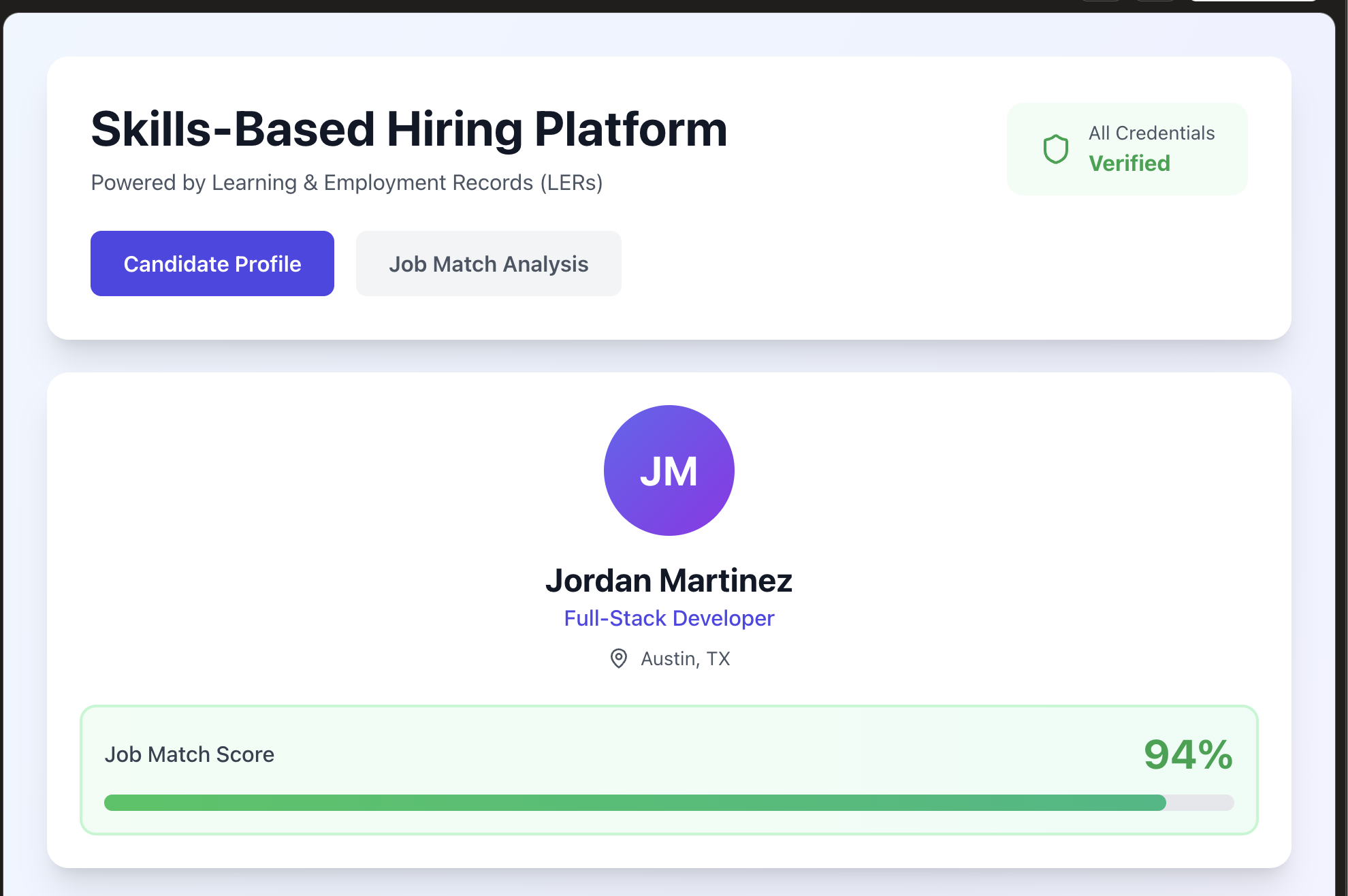
Overview
Focus Area
Technology and Educational Equity
Rethinking Pathways to Success
Skills
Web Design & Development
Applied AI
Research
The Problem: The Degree Gap
The degree gap is the earnings difference between those with a bachelor’s degree and those without one. This degree gap can persist even when individuals are otherwise similar in skill and experience level. Middle-skill jobs are the ones that are the most prone to a degree gap, or be subject to degree inflation: when a job that did not historically require a degree, nor requires any new skills, suddenly adopts a degree requirement.
This degree requirement forms a “paper ceiling,” disproportionately harming skilled individuals from low-income backgrounds. For employers, the degree requirement offers an easier way to make hiring decisions, without necessarily improving the quality of candidates. It effectively weeds out qualified candidates just for convenience, at the cost of disproportionately excluding those from low-income backgrounds.
The Shift: Skills-First Hiring
Skills-first hiring presents a shift in thinking about hiring practices. Instead of using the degree as the primary requirement, skills-first hiring looks at the explicit evidence of a candidate’s skills and uses those as the primary consideration of whether the candidate deserves that job.
However, employers face several issues. First, how can they verify if a candidate has completed that skill from a reputable place? Second, how can they compare skill levels between candidates? Lastly, what would cause employers to reject degree-first hiring and adopt skills-first hiring?
The primary technological solution that addresses all of the above challenges is learning and employment records (LERs). However, it is a complicated technology that exists in a very complex web of employers, government services, workforce associations, and schools.
In this project, I use the Diffusion of Innovations theory, coined by Everett Rogers, to analyze the adoption of LERs to enable skills-first hiring to spread. I also include technical information on how LERs function, which I learned directly from one of the premier technological experts of LERs, Philip Long.
While adoption is currently hovering around 3-4%, there are several promising organizations and workforce trends that may succeed in shifting the hiring landscape in the next 5-10 years.